
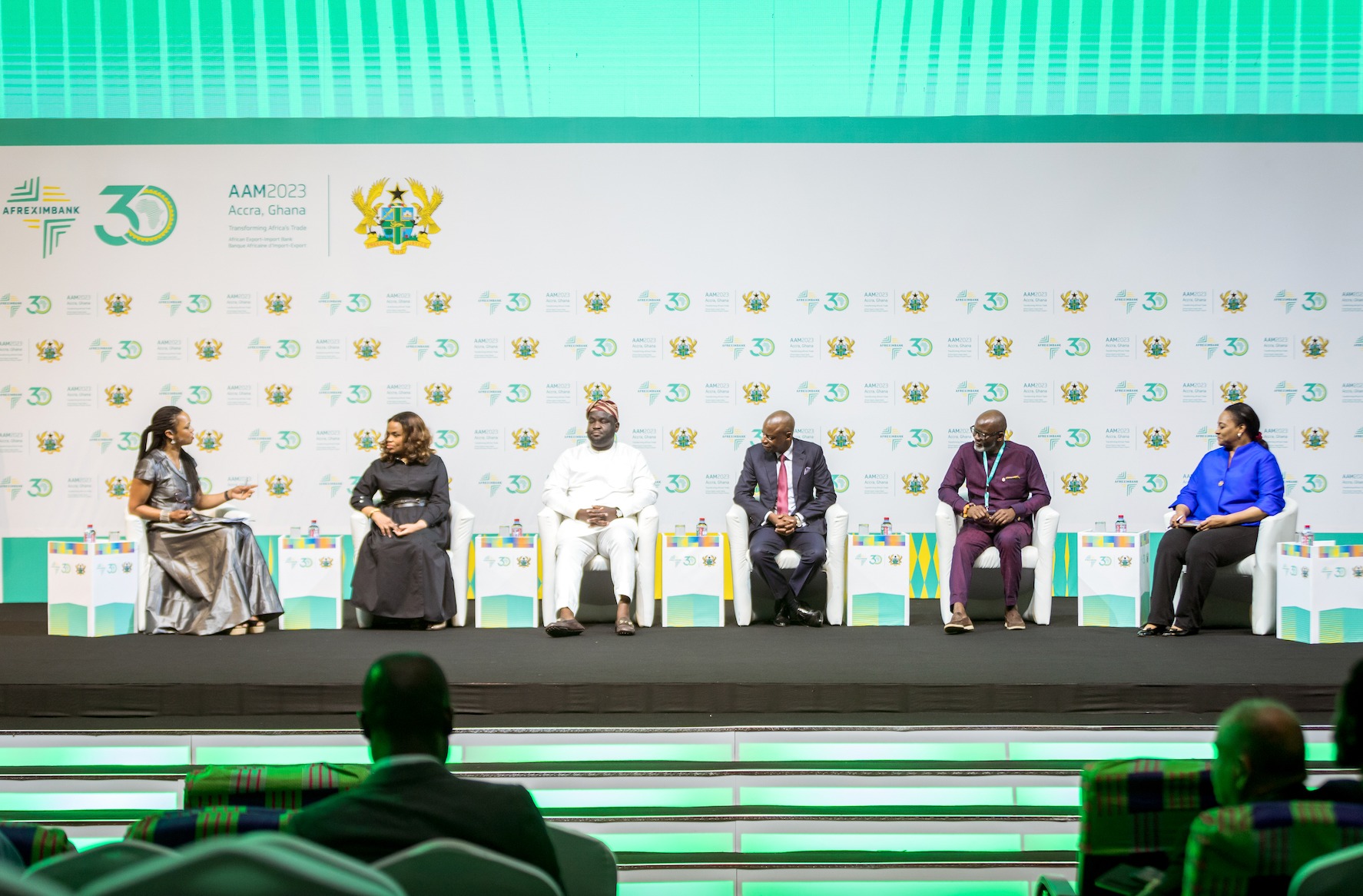
The 30th Annual General Meetings of the African Export-Import Bank (Afreximbank) The 30th Annual General Meetings of the African Export-Import Bank (Afreximbank) kicked off on Sunday, June 18, 2023 in Accra, with speakers highlighting the need to boost intra-African trade and the continent's integration in the face of challenges resulting from the impact of the global COVID-19 pandemic and economic problems linked to the crisis in Ukraine and other global conflicts.
The Afreximbank Annual General Meetings (AAM2023), which end on June 21, are also being held to celebrate the 30th anniversary of the founding of Afreximbank.
Egypt's Minister of Finance and Chairman of the Afreximbank Annual General Meetings, Mohamed Ahmed Maait, represented by Gamal Negm, Deputy Governor of the Central Bank of Egypt, told participants that Africans must work collaboratively to find integrated solutions to the new challenges facing the continent.
Mr. Maait praised Afreximbank's important role in developing and implementing solutions to Africa's challenges and expressed the hope that AAM2023 would lead to even more constructive solutions for Africa's problems, calling the Bank one of the African institutions implementing the African Union's (AU) Vision 2063.
Earlier, Dr. Honorable Ernest Yedu Addison, Governor of the Bank of Ghana, in his welcome address, said that Ghana was the most appropriate place to celebrate Afreximbank's 30th anniversary, given the Bank's role in the development and promotion of African trade and the fact that Ghana hosts the secretariat of the African Continental Free Trade Area (AfCFTA).
Dr. Addison said that Afreximbank had provided considerable support to Ghana and had, over the years, provided over two billion dollars to support the Ghanaian economy.
He commended Afreximbank for the approach it has taken to its work, emphasizing a collaborative approach in its relations with other continental institutions.
In his contribution, Wamkele Mene, Secretary General of the AfCFTA Secretariat, said that the AU's founding fathers had foreseen the need for Afreximbank by including in the OAU's founding treaty a vision of an integrated African market.
This vision was based on the objective of integrating African trade finance, he noted.
Describing Afreximbank and AfCFTA as twins born 30 years apart, Mr. Mene pointed out that if trade barriers were eliminated, but there was no trade finance, all efforts would be in vain. Similarly, if trade finance was available but trade barriers persisted and prevented trade, all efforts would be in vain too.
Mr. Mene praised the support and collaboration provided by Afreximbank in implementing the AfCFTA, including the introduction of the AfCFTA Adjustment Fund and the creation of the Pan-African Payment and Settlement System (PAPPS). This support is crucial as Africa seeks to rely on itself to create a better future, he added.
At the opening session of the first panel of the day, Mahamadou Issoufou, former president of Niger, said that Africa accounted for a significant proportion of the world's arable land and that it was time for the continent to be able to feed itself, stressing that a focus on agriculture and agro-industrialization would also lead to job creation.
Mr. Issoufou commended Afreximbank for its support of the AfCFTA project, which has included the provision of essential personnel, as well as investments, such as the AfCFTA Adjustment Fund to help countries adapt to AfCFTA and improve their ability to compete in the new trading regime, for which the Bank has already allocated $1 billion.
Afreximbank has also launched the PAPSS to enable intra-African trade payments in local currencies, he noted. It has also set up the Intra-African Trade Fair (IATF), an exchange platform that Africa needs to meet the needs of the AfCFTA.
The morning also featured panel discussions on 'Accelerating AfCFTA implementation', 'Building prosperity for Africans: the challenges of peace and security, and What it would take for Africa to feed itself - overcoming food security challenges for sustainable development in Africa', as well as a conversation with Aliko Dangote, Chairman of the Dangote Group.