

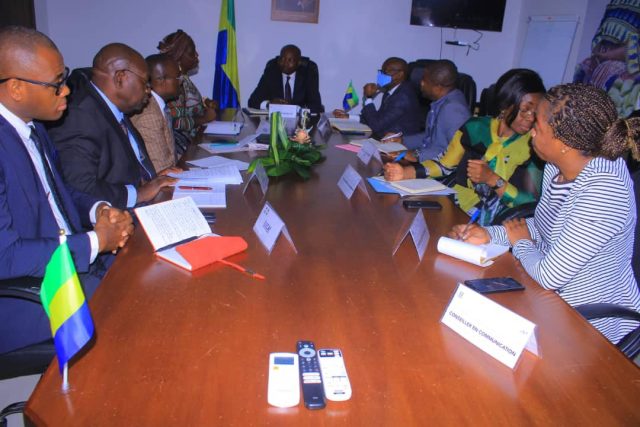
A delegation from the General Secretariat of the African Continental Free Trade Area (AfCFTA) recently visited Libreville as part of an initiative to evaluate trade quality along the Yaoundé (Cameroon)/Libreville (Gabon) and Libreville/Brazzaville (Congo) corridors. The mission's goal is to encourage member states to adopt trade measures that boost intra-community commerce.
After completing their visit to Cameroon from 19 to 21 February, the delegation moved to Gabon from 23 to 25 February. The experts aimed to assess the effectiveness and efficiency of the free movement of goods across borders in the Central African region through the identified corridors.
The delegation was welcomed by Emmanuel Eyeghe Nze, Minister Delegate for Trade, Small and Medium-sized Enterprises, in charge of National Entrepreneurship and the Social Economy. The mission involved evaluating the management of border crossings, identifying non-tariff barriers, analyzing cooperation among administrative entities involved in import-export processes, and examining transit and administrative procedures, as well as commercial practices. This effort aligns with the recommendations of the 35th Ordinary Session of the Conference of Heads of State, which endorsed the "Corridor" approach to address and resolve issues along these trade routes.
Key activities during the visit included inspections of port facilities, such as the port of Owendo and the New Port, to evaluate the infrastructure of the Gabon corridor. The delegation also participated in technical meetings with government agencies, including trade and customs departments, the Gabon Ports and Harbours Office, and transit authorities.
Under the AfCFTA framework, tariffs on 90% of liberalized goods are set to be reduced by 2030, with an additional 7% reduction planned by 2035. Participating countries are permitted to maintain tariffs on 3% of their goods as exceptions.
The AfCFTA, which came into force on 1 January 2021, represents the largest free trade area in the world by the number of participating countries. It consolidates a market of approximately $1.3 billion across 55 African Union member states, with a combined GDP of $3.4 trillion. Furthermore, the AfCFTA is expected to lift 30 million Africans out of poverty and increase the continent's income by $470 billion.
Credit:Gabon Review