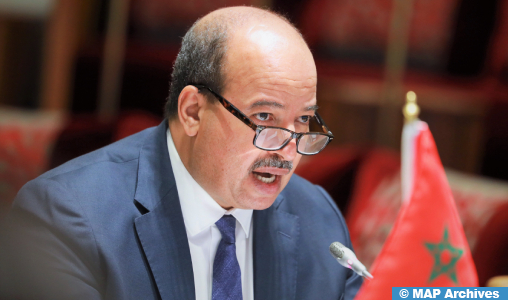
The implementation of the African Continental Free Trade Area (AfCFTA) is at the heart of the Kingdom of Morocco's interests, given its importance in changing the continental development model to become more capable of producing and creating opportunities for all, said the President of the House of Councillors, Enaam Mayara, in Johannesburg on Monday.
Speaking at the opening of the second ordinary session of the sixth legislature of the Pan-African Parliament (PAP) at its headquarters in Midrand, on the outskirts of Johannesburg, Mr.Mayara said that this major continental project would create more jobs for young people, save 30 million Africans from extreme poverty, improve the incomes of 68 million others and increase the continent's wealth by 450 billion dollars.
Using an ambitious methodology, Morocco has endeavoured to contribute to the construction of a continental model of "common development", through a series of integrated projects and programmes in a large number of African countries, aimed at promoting infrastructure, university and vocational training, strengthening food and energy sovereignty, health security, making the most of internal resources and strengthening industrial systems, he said.
He also emphasised that the Kingdom of Morocco is also working to exchange experiences and best practices relating to economic and development programmes, as well as to strengthen the financial and banking systems of a large number of countries on the continent. These efforts, he pointed out, have led to a substantial 9.5% annual average increase in the total value of Morocco's bilateral trade with African countries.
In the same line Mr. Mayara welcomed the holding of this parliamentary session under the theme "Accelerating the implementation of the African continental free trade area", in perfect harmony with the theme chosen by the African Union for the year 2023. This session, he argued, was thus a "working session" and an important step on the road to contributing to the success of the major continental economic projects aimed at establishing the largest free trade area in the world, with a market of some 1.3 billion people and a GDP of 3.4 trillion dollars.
He recalled that at the Extraordinary Summit of Heads of State and Government of the African Union in Kigali on the Continental Free Trade Area, His Majesty King Mohammed VI, may God assist him, declared: "A continental free trade area stimulates capacity, knowledge and intelligence, and above all responds to the desire of our young people to build a strong and integrated Africa".
In parallel with the strengthening of Moroccan investments in Africa, which consist essentially of direct investments in sub-Saharan Africa and which have made the Kingdom the leading African investor on the continent, and in accordance with the spirit of cooperation, solidarity and synergy which establishes the core of the doctrine of cooperation between Morocco and its African brothers, the Kingdom is committed to investing to strengthen continental food security, by accompanying a group of African countries in building advanced agricultural strategies to strengthen food sovereignty and improve the ability to compete in international agriculture and access new markets, he said.
The President of the Chamber of Councillors also indicated that Morocco is also working, through the Office Chérifien des Phosphates (OCP), to develop an advanced continental value chain that will enable Africa, within a few years, to have fair and equitable access to sufficient quantities of fertiliser.
"The Kingdom has a clear vision of implementing projects that will change the face of agriculture on the continent and improve its food security. A case in point is the initiative to establish an industrial platform for fertiliser production in Ethiopia at a cost of 3.7 billion dollars, with an annual production capacity of around 2.5 million tonnes of fertiliser for the local and export markets. We also have plans to open a plant in Ghana, which will be dedicated to fertiliser production, and a second plant in Nigeria, which will be dedicated to the agricultural ammonia industry", he explained.
On the energy front, he maintains, Morocco and the Federal Republic of Nigeria are working on the construction of a gas pipeline between the two countries that will cross a group of countries in the west of the continent. This is an ambitious initiative to develop the potential of African resources, reshape the regional energy map, promote the logistical and competitive capacities of African gas and strengthen its position on the European market," he explains.
In the same vein, Mr.Mayara affirmed that all these initiatives are an expression of the faith of Moroccans and their Kings in the principles of South-South cooperation, solidarity and cooperation between the countries of the African continent. "This is not a new choice, temporary or linked to any document, but rather a reference doctrine for Moroccan diplomacy since independence", he said.
He went on to explain that this doctrine was demonstrated by Morocco's hosting, support and training of the liberation armies of several African countries, including Algeria, Angola, Mozambique and Cape Verde, in their fight against colonialism, as well as its support for African liberation movements, foremost among which was the quest by the great African leader Nelson Mandela to free his country from the apartheid segregationist regime, following his military training in Morocco in 1962.
It is with this in mind and in accordance with the Royal High Directions that all Moroccan institutions now place African action at the forefront of their priorities and interests, he added, arguing that this is the approach adopted by the Parliament of the Kingdom of Morocco, in order to promote coordination with national parliaments, the Pan-African Parliament and regional parliaments.
"We are reaching out to all to exchange experiences and best practices and to work to meet the challenges facing our countries, just as we are also expressing, from this rostrum, our support for all serious parliamentary initiatives aimed at strengthening institutional cooperation and joint reflection in order to bring about models of continental parliamentary cooperation that follow bilateral and multilateral dynamics, in particular to meet the challenges linked to food security, water scarcity, the growing risks posed by terrorist groups and armed movements", stated Mr.Mayara.
It is also a question, he notes, of combating the exploitation of children in conflicts, clandestine migration and human trafficking, in addition to meeting the challenges of digitisation, the fourth industrial revolution, the fight against climate change and other issues of common interest on the continent.
"Morocco's determination to develop cooperation and solidarity with all its African brothers is matched only by its firm will to succeed in all the institutional projects on which the African Union is currently working, foremost among which is the strengthening of the role of the Pan-African Parliament as a concrete expression of the continent's motto 'One Voice, One Continent'", he assured.
He thus maintained that the institutional development initiated by the African Union could not succeed without concerted joint efforts and the strengthening of unity and stability in all the countries of the continent, according to an approach that would enable us to move up to the maximum speed of development in a way that is fair and equitable between all the components of our continental institutional family.
MAROC Dipomatique