
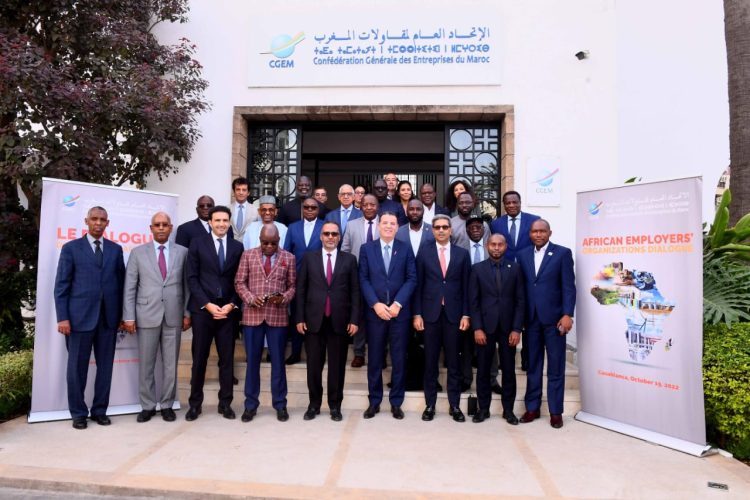
A dialogue between African employers was held today in Casablanca, on the initiative of the General Confederation of Moroccan Companies (CGEM), in the presence of presidents and representatives of more than 20 employers' organisations from across the continent.
The aim of this meeting was to establish a practice of permanent exchanges between representatives of the African private sectors and to create new synergies to promote intra-African trade—which does not exceed 16% of total trade—and investment and co-investment that create added value and jobs.
In a global economic climate marked by successive crises impacting the continent's economies in the same way as those of the rest of the world, it is vital for Africa's private sectors to work closely together and build mutually beneficial partnerships to boost the resilience of the continent's economy and position Africa at the centre of the global drive to revive and build new industrial value chains.
Considered to be the continent of the future, Africa has the resources to match its ambitions: a young, connected population, a wealth of natural resources with significant potential for local processing, abundant sources of renewable energy, young, innovative entrepreneurs and a continental free-trade area giving access to a market of 1.2 billion consumers.
These assets must be exploited responsibly to bring about an inclusive and sustainable transformation of the continent, and the African private sector is well aware of the role it has to play in this.
This dialogue between African employers was structured around 3 axes:
- African economic recovery in the current economic context marked by perpetual change: what levers and what role for the private sector in transforming challenges into opportunities?
- The role of the African private sector in the successful implementation of the African Continental Free Trade Area (AfCFTA)
- Building complementary industrial value chains in Africa to enhance continental integration and promote shared growth
The discussions produced a number of conclusions and recommendations, including the urgent need to further strengthen knowledge, cooperation and trust between Africa's private sectors, through regular structured dialogue, and to improve public-private dialogue as a key factor in development.
The representatives of the continent's employers also emphasised that Africa's development depended on exploiting and transforming the countries' resources, particularly in terms of renewable energies, and accelerating industrialisation by focusing on technology and innovation. To achieve this, regional and continental cooperation should take the form of catalyst projects such as the Africa-Atlantic Gas Pipeline.
The participants in the Dialogue also undertook to work together to identify complementary industrial value chains between their countries and to promote "Made in Africa" and "Made with Africa".
Efforts will also be pooled to support the acceleration of the implementation of the AfCFTA in a responsible manner, so as to promote intra-African trade. To this end, the private sector's contribution to the AfCFTA Business Summit is essential.
In addition, the African employers' associations will be working to establish an attractive and widespread continental business climate to promote investment in priority sectors such as renewable energies, agri-food, infrastructure, industrial transformation, health and digital technology.
Private sector representatives will continue to work to facilitate access to finance by forging more public-private partnerships with lenders. They will also work to further promote start-ups and entrepreneurship among women and young people.
The issue of human capital was also central to the discussions. Through the launch of targeted, pooled programmes, African employers intend to strengthen the skills of the continent's talents and offer them an attractive environment in which to flourish.
Finally, it was decided to launch discussions with the African Union on the launch of the Union of African Employers.
Credit:maroc-diplomatie