
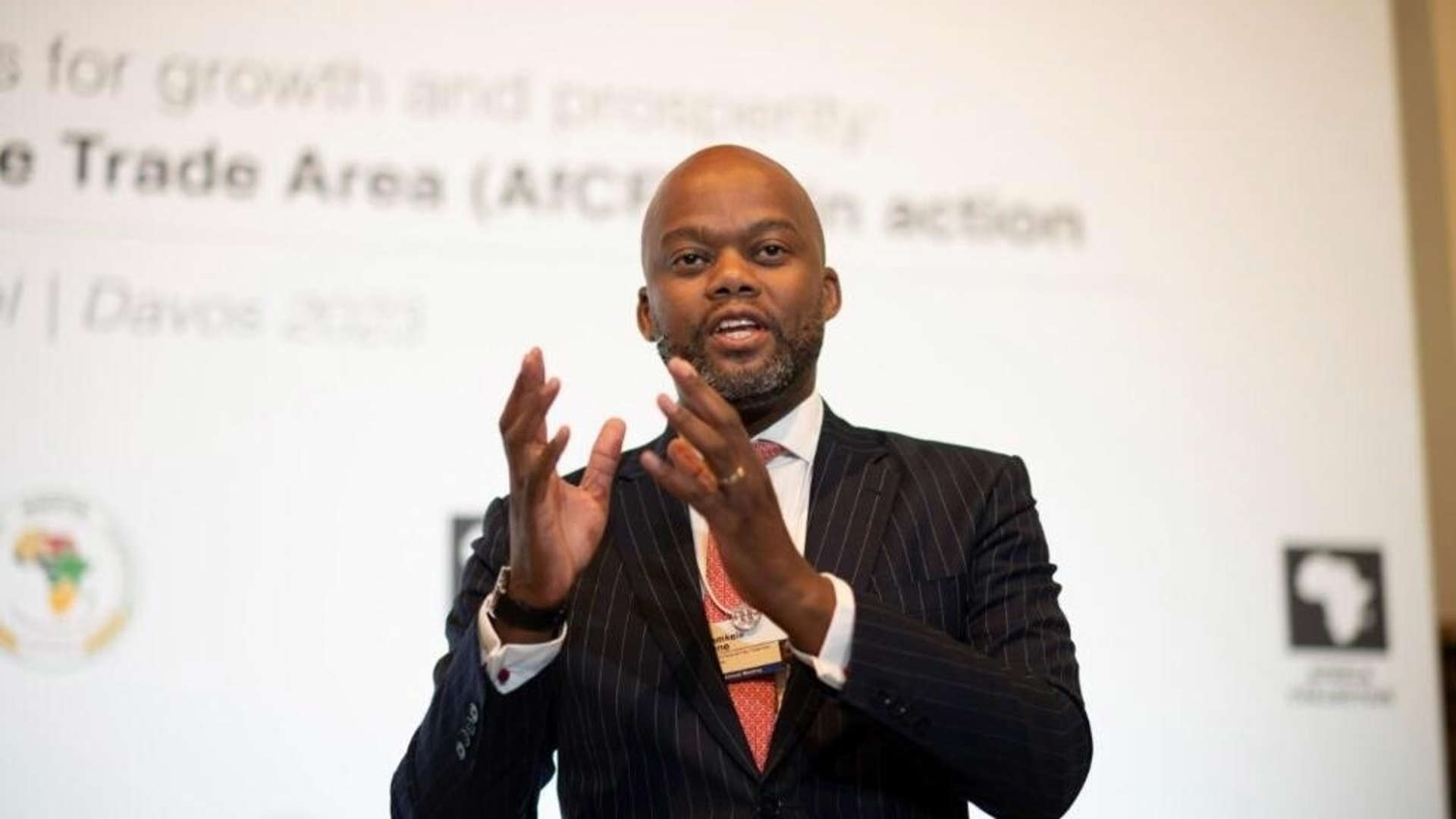
He's a man that's that is tough to meet. All last week, he had one meeting after another at the World Economic Forum in Davos, which each year brings together the world's economic and political elite in the Swiss Alps.
Meet South African Wamkele MENE, Secretary General of AfCFTA, the African Continental Free Trade Area.
RFI: What's an AfCFTA Secretary General doing at the World Economic Forum?
Wamkele Mene: First and foremost, we came to Davos to show that the African Continental Free Trade Area, the AfCFTA, is a high-potential market for investment. That was our main mission. The second, and equally important, objective was to present the AfCFTA report produced in collaboration with the World Economic Forum. This document is designed to enable international investors to better understand and identify investment opportunities in the AfCFTA market.
We have had meetings with leaders of multinationals, from global car manufacturers to giants in the agri-food and raw materials industries. They're all very interested. They want to know more about the potential benefits they can derive from the AfCFTA market.
And I have to say that their comments have been very encouraging. In these times of high geo-economic and geopolitical tensions, they are indeed looking for niche markets where they can invest and set up alternative value chains for their investments, for their products, but also for their services. I think we have a really unique opportunity as an African continent. So, throughout the week we've been trying to present ourselves as this alternative market, this place where they can set up new value chains.
You mention geopolitical tensions, but Africa is not spared.
Yes, of course. There's a reality we have to face, and we have to be honest about it. We face many challenges. Some are political, others are macro-economic, such as the foreign exchange and liquidity crises. But these are not challenges that are peculiar to the African continent. Climate change, for example, is not unique to Africa, and I think investors understand that.
It's all a question of risk assessment, of how much risk to take before investing. But this happens in other parts of the world, not just Africa. But I think that well-informed investors understand the global context and are prepared to invest in Africa in spite of everything.
Last October in Accra [headquarters of AfCFTA, editor's note], you launched the Guided Trade Initiative (GTI). What does it involve?
In 2020, the Assembly of Heads of State and Government of the African Union decided that we had to start really trading with each other. So, last October, we identified almost a hundred products that are marketed throughout Africa, and seven countries whose customs systems were in line with the procedures required by AfCFTA for preferential trade. And this pilot project has been a resounding success. It demonstrated that the AfCFTA is a reality.
So it's a big step that's been taken?
A giant step. When you think about it, there has never been preferential trade between the regions of the continent. For the first time, we had products from North Africa, in this case air conditioners made in Egypt, exported to Ghana. Kenyan tea, a value-added agricultural product, was shipped to West Africa. This had never happened before in Africa. We always traded with Europe, and sometimes we traded with Europe to trade with each other. So, we've taken a giant step forward by dismantling this old model of trade and this old model of the African economy, which by its very nature was colonial.
How do you convince other countries to join this initiative?
Many countries are in the process of setting up the customs systems required by the AfCFTA. More and more countries are saying they will be ready when we launch a new Guided Products Initiative in June. More and more countries are saying they are ready. More and more companies have also expressed an interest, including multinationals. Here in Davos, for example, we met three multinationals with a presence in Africa who told us they wanted to be part of this initiative. When I was in Tokyo last December, Japanese companies expressed the same interest. The interest is immense, and not just on the part of governments or the public sector, because, as I said, this is the first time in 70 years that Africa has been trading with itself.
What about the AfCFTA Certificate of Origin? What is required to obtain it?
The threshold for “made in AfCFTA” is quite high. It must contain at least 40 % of local content. For your products to obtain the AfCFTA Certificate of Origin, which gives them access to reduced customs duties, you need to prove and demonstrate that they are manufactured in the zone. Then the Certificate of Origin can be issued. With the initiative launched in October, 96 products have obtained this certification. Agricultural products, manufactured goods, tiles, air conditioners, beauty products and alcoholic beverages have all obtained the made in AfCFTA certificate. There is now a very wide range of products.
Credit: RFI