


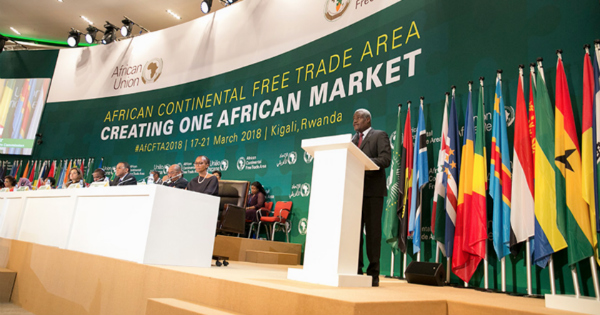
The establishment of the African Continental Free Trade Area (AfCFTA) was a central topic at the African Union summit held in Addis Ababa on Saturday, 18 February. Initiated in 2012, the AfCFTA officially came into force on 1 January 2021, aiming to promote intra-African trade and reduce reliance on traditional North-South trade patterns, which were further destabilised by the Covid-19 pandemic.
During the summit, Azali Assoumani, the new Chairman of the African Union, emphasised the need to use the AfCFTA as a lever to ensure it does not become just another "missed opportunity" for the continent. Moussa Faki, Chairman of the African Union Commission, also highlighted the challenges, openly criticizing the "lack of political will" among member states to implement the free trade area effectively.
Intra-African trade remains limited, accounting for less than 20% of the continent's total trade volume. To address this, the AfCFTA launched the Guided Trade Initiative in Ghana last October. This pilot program identified around a hundred goods and commodities produced or processed within the continent, including ceramic tiles, air conditioners, tea, and sugar. Eight countries—Cameroon, Egypt, Kenya, Tanzania, Tunisia, and others—are participating in the initiative, which is expected to extend to all 46 AfCFTA countries in the future.
Stimulating intra-African trade will require measures such as the partial or total elimination of customs duties and the implementation of a pan-African payment and settlement system to simplify administrative and banking procedures between countries.
UN Secretary-General Antonio Guterres underscored the transformative potential of the AfCFTA, describing it as a path to creating jobs and generating new sources of prosperity for Africans.
According to the United Nations Conference on Trade and Development (UNCTAD), the AfCFTA represents a market worth approximately $1.3 billion.
Credit: rfi